
What it is
OpenTofu keeps a state file: a list of which real resource each block in your configuration created, plus the values it cannot read back. Whoever can write that file can change anything in it, and losing it means OpenTofu no longer knows what it owns.
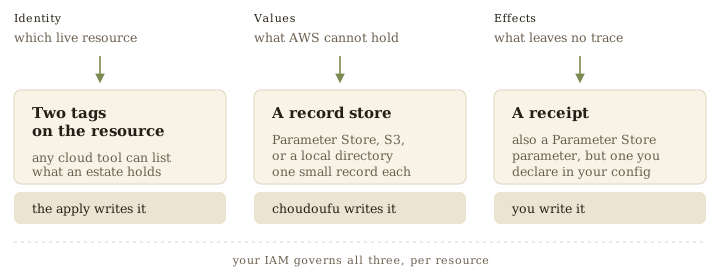
choudoufu is OpenTofu with a different backend, the live backend. It puts ownership on the resources themselves and keeps the rest in small records, so there is no single file to guard, lock or lose.
Four words
An estate is one configuration and everything it owns. You name it once,
in a file called estate.chdf.hcl, and the name is the unit of ownership and
of access control.
A marker is the estate’s name written on a resource, with the address of
the block that declares it. On AWS it is two tags, tofu-estate and
tofu-address. A count instance whose members the configuration does not
tell apart carries a third, tofu-slot. On Kubernetes it is one label. The apply writes it on the
create call, so a resource that exists has one.
A record holds what cannot be read back from the live resource: a password the API never returns, a random name, the fact that a script ran. There is one per resource, in the record store, which is a local directory, an S3 bucket, or Secrets in a cluster.
1. The marker says what you own
A plan finds your resources by their markers, reads each one live, and compares it with your configuration. Nothing else is asked who owns what. So any cloud tool can list an estate, and your own IAM or RBAC decides who may change which resource, one resource at a time.
aws resourcegroupstaggingapi get-resources \
  --tag-filters Key=tofu-estate,Values=prod-networking
Identity has the rules, including what happens for a resource type that has no tags.
2. The record holds the rest
For most resources, losing the record costs a slower plan, because the marker
still owns the resource. A few resources have no live object at all, a
random_pet or a null_resource. These are called record-backed, and
for them the record is the only copy.
Every write to a record is conditional: it succeeds only if nobody else changed the record first. Nothing is locked, so a crashed run leaves nothing held. Records has the two kinds and the three stores, and Two runs at once has the races.
The record store holds what a state file holds, secrets included, so it needs the care a state bucket needs. Secrets in the record store starts there.
The state file is still there, as a cache
Every run writes an ordinary state file on the machine that ran. It is never
asked who owns what, and deleting it changes no plan.
The disposable cache says what it buys.
Remove the live block, keep that file, and stock OpenTofu carries on with
it, which is what makes leaving cheap.
What it costs
A plan reads the live system and not a file, so it does more work. What a plan costs has the numbers. A marker has to be knowable before the resource exists, which limits what a configuration may compute in a name. Compatibility reference lists what that rules out.
Coming from Terraform or OpenTofu? What changes from a state file is the side-by-side.