Effects#
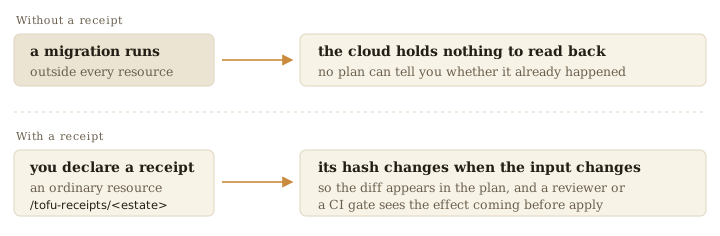
A migration that ran. A cache that was invalidated. A notification that was sent. None of them leaves anything in the cloud to read back, so no plan can tell you whether it already happened.
A receipt is how you make it visible.
What a receipt is#
An ordinary resource you declare, by convention an SSM parameter at
/tofu-receipts/<estate>/<effect> holding a hash of the effect’s input.
A record store can be backed by Parameter Store too, so both can end up as parameters in the same account. The difference is who owns them. A record is written by choudoufu and its format is internal. A receipt is written by your configuration, appears in your plan, and is yours to read.
It goes through the ordinary plan and apply cycle. Its diff appearing in a plan is what tells a reviewer or a CI gate that this apply will trigger something outside the resources being managed.
choudoufu never runs the effect#
This is the part that makes the diff mean something. plan and apply touch
the receipt resource and nothing else. The migration itself runs in the layer
above, a CI step or a runbook, which sees the proposed receipt change, runs the
real effect, and lets apply write the new value only once the effect succeeded.
If the tool ran the effect itself, the diff would stop being a preview of what is about to happen and become the thing happening mid-plan. That is a provisioner.
choudoufu does run provisioners, once an estate declares a record_store
(before that it refuses them, because a failed one has nowhere to be
remembered). But a provisioner is not a smaller receipt, and reaching for one
here would answer a different question. A provisioner runs when its resource is
created and never again; nothing about it is re-examined on a later plan, and no
plan shows you that it is about to run. A receipt tracks staleness across a
resource’s whole lifetime: its diff is the standing answer to “have this
effect’s inputs changed since it last ran”, asked on every plan, for as long as
the resource exists. Only one of those is reviewable before the fact.
The semantics are at-least-once. If the effect runs but the process dies before the receipt is written, the next plan proposes the same change and the effect runs again. Under-running never happens silently, and every unconfirmed effect stays visible as a pending diff.
choudoufu does not write receipts. It lints them, enforcing that the value is a
hash or constant and never a SecureString, that nothing references a
receipt’s attributes, and that inputs name secrets by pointer rather than by
value.
Why a receipt is not a record#
Enforced rather than advised. A key_prefix whose first segment is
tofu-receipts is a configuration error, so a record can never land in the
receipts namespace.
Visibility is why. A receipt is AWS-native so its value stays readable with a
plain aws ssm get-parameter, by someone with read-only IAM and no choudoufu
binary. A record-store payload is tool-internal by
design. Moving a receipt onto it would trade a one-line CLI call for
choudoufu’s own JSON envelope, which is strictly worse for the one artifact
whose job is being legible to someone not running the tool.
The tempting mistake#
Now terraform_data is record-backed, its triggers_replace looks like a
pseudo-receipt. Do not use it that way. It hides the fingerprint in the tool’s
own store instead of a declared resource, and collapses a receipt into “did an
input change”, with no existence flavour, no hash flavour, and no naming
convention the lint rules recognise.
terraform_data is for the graph, ordering an apply, feeding
replace_triggered_by, or standing in for a resource that does nothing.
Receipts are for external effects. Keep them apart.
live/RECEIPTS.md
has the pattern and the reasoning behind each guard.