
Records
Ownership lives on the resource, as a marker. Everything else a run has to remember between applies lives in the record store: one record for every managed resource instance, written by choudoufu, in a place you choose.
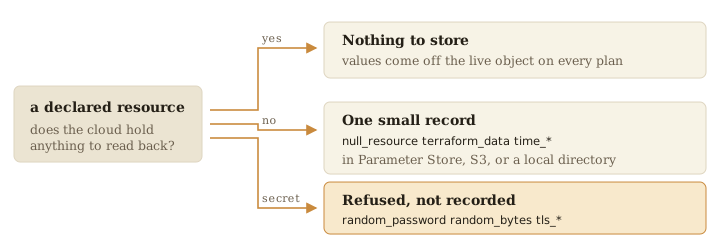
Two kinds of record
kind | Written for | Holds | Losing it costs |
|---|---|---|---|
identity | A resource with a live object, which is most of them | What a read of the live object cannot give back: an import identity, arguments the API never returns, whether a create-time provisioner ran, and on Kubernetes the label and annotation keys the configuration last declared | A slower or noisier plan. Ownership is the marker and does not depend on the record |
object | A record-backed resource, one with no live object: null_resource, terraform_data, random_*, time_*, tls_* | The whole value, the provider’s private data, and which attributes were sensitive | The resource. The record is the only copy |
The resource tier lookup uses a similar word for a different thing. A record-carried type has a live object and no tags, so its record holds its identity. A record-backed type has no live object, so its record holds all of it.
The kind inside the record decides what a plan may do with a record that no
configuration declares. Only an object record is proposed for destroy.
A record is never consulted for ownership, and its values are never folded
into a marker: an identity-bearing argument is evaluated over var, local,
path, terraform and tofu alone. A lost object record can still cost
more than itself. name = "svc-${random_pet.suffix.id}" is the ordinary
shape, and losing the pet’s record regenerates the pet, so everything named
after it is proposed for create under a new name.
Recover an estate has the
procedure.
Three stores
| Backend | Records are | For |
|---|---|---|
local | Files in .tofu-records beside the module | One operator, or a demo. It is what an estate gets when it declares nothing |
s3 | Objects in a bucket you own | A team on AWS |
kubernetes | Secrets in a namespace you own | A team on a cluster, with no AWS account involved |
# estate.chdf.hcl
estate = "my-estate"

record_store "s3" {
  bucket = "my-records-bucket"
}
All three give the same guarantees; a run cannot tell them apart.
Every write is conditional. A create succeeds only if the record does not
exist, and an update or a delete only if the record still has the version the
writer read. A losing writer gets a named conflict and changes nothing. The
remote stores lock nothing, so a crashed run leaves nothing held; the local
store takes a lock file for one write.
Two runs at once has the cases.
A run reads its estate’s records whole before it plans: the read is complete or the run fails, never a smaller estate.
Each record is its own object, tagged or labelled with the estate’s name the way a managed resource is. One bucket or cluster serves any number of estates, and your IAM or RBAC decides who reads which.
It holds secrets
A record store holds what a state file would have held. Under the default,
strict { secrets = "store" }, a generated password is recorded in clear,
and so is a database password the API never returns. Whoever can read the
store can read them, so pick who that is before you pick a backend.
Secrets in the record store says exactly
what is recorded and what secrets = "refuse" changes.
Where things are stored has the layout of each store, and What you set up by hand has what must exist before the first plan.