
What it is
 Optional: hand this page to your coding agentThe steps work by hand too.
Show the whole prompt
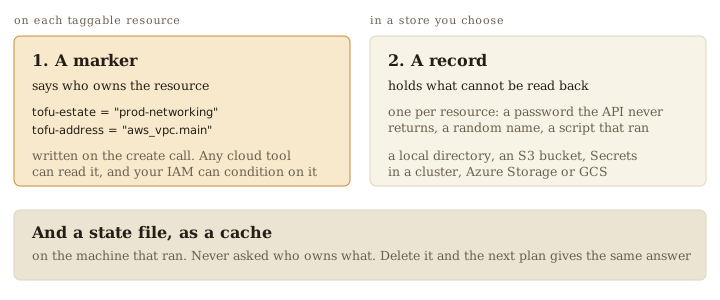
Read https://intentius.io/choudoufu/how-it-works/ and explain what choudoufu would change for the configuration in this repository. Change no files. Never apply or destroy (`choudoufu apply`, `choudoufu destroy`, `tofu apply`), approve a saved plan, or merge; never edit or remove an owner tag by hand.choudoufu is OpenTofu with ownership on the resources. Each taggable resource carries its estate’s marker, and small records hold the rest.
Three words
Section titled “Three words”An estate is one configuration and everything it owns, named once in
estate.chdf.hcl, the live backend.
A marker is a tag or label holding the estate name. The block address sits
beside it: a tag, a label, or on Kubernetes the
choudoufu.intentius.io/tofu-address annotation (Identity).
A record holds what a read of the live resource leaves out, such as a generated password (Records).
The marker says what you own
Section titled “The marker says what you own”A plan finds resources by marker and reads each one live. Any tool can list an estate:
aws resourcegroupstaggingapi get-resources \
  --tag-filters Key=tofu-estate,Values=prod-networking

kubectl get configmaps,services -A -l tofu-estate=prod-networking
Your backend and the live backend
Section titled “Your backend and the live backend”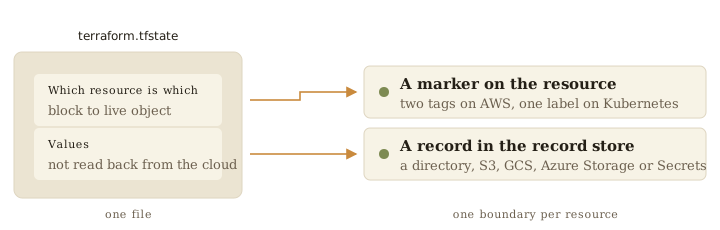
| With a backend block | With the live backend | |
|---|---|---|
| Permission unit | the state file | each resource |
| To narrow access | split the state | write a policy |
| Two applies at once | take turns on the state lock | run together, one conditional write per record |
| Losing the state file | restore it from your backend’s versioning | plan again, since the file is a cache |
Two runs, and many roots
Section titled “Two runs, and many roots”Resource-level concurrency covers two applies to one estate. One plan, one apply, across roots covers one run over several roots, with Terragrunt, Atmos or a composed root.
Upstream
Section titled “Upstream”choudoufu forks and tracks opentofu/opentofu under MPL-2.0. It is not affiliated with OpenTofu or the Linux Foundation, owner of the OpenTofu trademark.