Lifecycle Models
Most infrastructure tools ship their lifecycle model inside the compiler, so you take both or neither. chant separates them: pluggable lexicons in, pluggable lifecycles out, pure synthesis in the middle. You bring the lifecycle and chant runs it.
This page makes the axes explicit so the rest of the docs can point here instead of re-deriving the argument. For the cost side of the trade — what an authoritative state file actually buys and charges — see State and Governance.
Three axes
Section titled “Three axes”Any lifecycle model is a point in a three-dimensional space.
1. Where truth lives
Section titled “1. Where truth lives”| Truth lives in… | Called | Examples |
|---|---|---|
| A state file | Authoritative | Terraform, Pulumi |
| The live system | Observational | query the cloud, diff against a snapshot |
| The source code | Source-as-truth | GitOps reconcilers |
2. Reconciliation direction
Section titled “2. Reconciliation direction”| Direction | Name | What it does |
|---|---|---|
code → cloud | Apply | push declared source into the live system |
cloud → code | Sync | pull live reality back into source (open PRs) |
| none | Observe | report drift, change nothing |
3. Who answers “is this mine?”
Section titled “3. Who answers “is this mine?””| Answered by | Mechanism |
|---|---|
| A trusted state file | the tool consults its own record |
| A live ownership marker | a tag/label on the cloud resource |
| Nobody | the tool escalates rather than guessing |
This third axis is the one most tools collapse into the first: they answer “is this mine?” from the same state file they host. chant separates them on purpose.
Where chant sits
Section titled “Where chant sits”- Truth is the live system. chant reads the cloud directly. The snapshot it stores is evidence for diffing, never a source of truth.
- Reconciliation direction is a per-environment choice. A dev environment might only observe; staging might reconcile
cloud → code; production might applycode → cloudbehind a gate. Same project, different dial positions. - Ownership is answered by live markers. A chant-managed resource carries a marker — a standard tag or label — that records the stack identity on the resource itself. “Is this mine?” is answered by reading that marker, never by a record chant has to lock.
Declaration and ownership are independent
Section titled “Declaration and ownership are independent”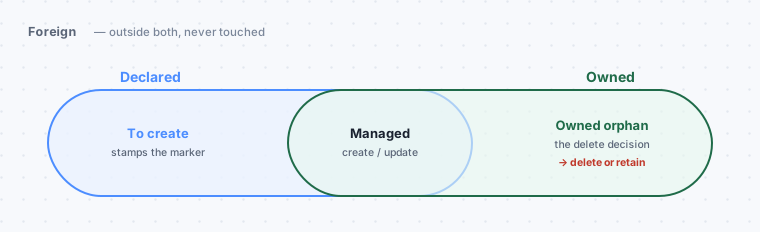
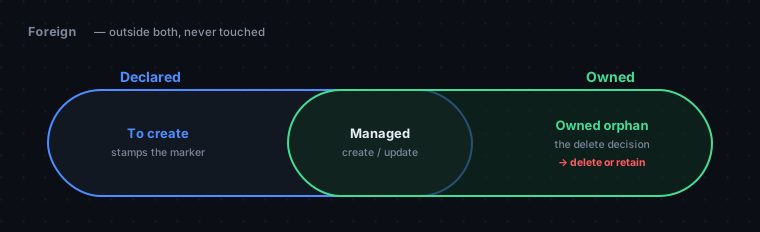
Declaration is your source — what your TypeScript exports. Ownership is a fact recorded on the live resource — a marker chant reads, never a record it locks. Because the two are separate, dropping a resource from your source does not by itself delete it. chant lifecycle plan proposes a delete only for a resource that is owned and no longer declared. Three levers decide what happens to it.
ApplyOp delete: "never"— stack-wide. Apply never prunes, so an undeclared resource is left alone.- Strip the marker — per-resource. The prune is marker-scoped, so an unmarked resource is foreign and never touched.
- Spec-true retain — the target spec’s own knob. CloudFormation
DeletionPolicy: Retain, the K8s prune selector. chant passes it through rather than inventing one.
No hosted state file decides this. A resource lives or dies based on what you declare and what its live marker says, which is why the snapshot can be deleted between runs with no change in behavior.
The dial
Section titled “The dial”The three axes collapse, in practice, into one dial chosen per environment:
observe → reconcile → authoritative(report) (cloud→code (code→cloud PRs) apply)- observe —
chant lifecycle diff --live/WatchOp. Detect drift, change nothing. - reconcile —
ReconcileOp. Open PRs that pull live reality back into source. - authoritative —
ApplyOp. Push declared source into the cloud, deleting owned orphans.
You turn the dial up per environment as trust and tooling allow. Nothing forces an environment past the position you chose for it.
The invariant that holds the line
Section titled “The invariant that holds the line”There is exactly one rule that prevents this model from quietly becoming the thing it avoids:
The projection reads ownership from the live marker, never from the snapshot.
The moment a mutation trusts the snapshot — uses it to decide what to create, update, or delete — the snapshot becomes load-bearing, and you have rebuilt an authoritative state file under a different name, with all its costs. chant’s change set (chant lifecycle plan) reads ownership only from the live resource. The snapshot can be deleted between runs with no change in behavior. That is the test, and chant holds to it by construction.
See also
Section titled “See also”- State and Governance — what a state file costs, and why governance is the part that matters
- Drift Detection — the observe position, in depth
- How chant compares — these axes mapped across tools
- Ops — the reconcile (
ReconcileOp) and apply (ApplyOp) workflows - Contributing a Lifecycle — bring your own lifecycle: write one as Ops, or plug one in
lifecycle-reconcile-awsexample — the dial on a real stack: deploy -> drift -> diff -> reconcile / apply