
Have an agent change a pull request
 Optional: hand this page to your coding agentThe steps work by hand too.
Show the whole prompt
Read https://intentius.io/terragucci/guides/agent-change-a-pull-request/.
Add the `agent.comment` block to terragucci.yml, run `npx terragucci config check` and `npx terragucci init`, and open a pull request with the result.
List the machine user, token scopes, secrets and ruleset I must set; do not create tokens or secrets yourself.
Never apply, approve (a pull request review or `terragucci approve`), override a policy denial (`terragucci override`), use `--mode apply`, or merge; never touch `.chant/allowed_signers` or `chant/lifecycle`.One of four features that run a model; the others are summarizing a refused wave, fixing drift and reviewing a pull request. It is off unless agent.comment is set; every other feature runs without an agent (what needs an agent).
Result
Section titled “Result”A pull request comment such as:
/terragucci agent rename var.bucket to var.bucket_name in app and its callersA coding agent makes the change and terragucci commits it to the pull request’s head. The commit is planned like any other; nothing is applied or merged.
Prerequisites
Section titled “Prerequisites”| You need | Why |
|---|---|
| The pipeline from Get your first plan note | the agent jobs are written into it |
On GitLab, comments: and its pipeline schedule |
a merge request note starts no pipeline; the comments job reads /terragucci agent |
| An Anthropic API key in your forge’s secrets | the default command runs Claude Code |
| A token for the agent’s commits in your forge’s secrets (step 1) | a commit sent with the job’s own token starts no workflow run, so the change would not be planned |
-
Make the agent’s token. Keep it in a secret such as
AGENT_FORGE_TOKENand the model’s key inANTHROPIC_API_KEY.Setting Value Who a machine user with write access, outside CODEOWNERSToken fine-grained, for this repository alone Contents read and write Pull requests read and write Workflows none, so GitHub refuses any change it sends to .github/workflows/Default branch ruleset a pull request and one approval of the latest change required, with no bypass for the machine user Setting Value Who a bot user or project access token with the Developer role, outside CODEOWNERSToken scopes apiandwrite_repositoryVariable AGENT_FORGE_TOKEN, masked; the model’s key inANTHROPIC_API_KEY, maskedDefault branch protected, with the bot off the push and merge lists GitLab also needs
comments:beside theagentblock. Thecommentsjob starts the agent’s pipeline on the default branch with its own job token, so it runs as the user who owns the comments schedule.Setting Value Who a machine user added as a collaborator with Write access Token scopes write:repositoryandwrite:issueDefault branch the machine user stays off the push, approval and merge allowlists -
Turn it on. Add the
commentkey to theagentblock ofterragucci.yml:agent:via: forgetoken_env: AGENT_FORGE_TOKENcomment:key_secret: ANTHROPIC_API_KEYmax_turns: 30timeout: 30token_envnames the secret with the agent’s token.comment: truetakes every default, listed in terragucci.yml keys. -
Check the file and write the pipeline, then merge to the default branch, which comment workflows run from:
Terminal window npx terragucci config checknpx terragucci init -
Ask. Write
/terragucci agentand the ask on one line. The reply links the commit and names the files it changed.

The commit records the ask and who made it on which pull request:






Agent permissions
Section titled “Agent permissions”| Job | Does | Holds |
|---|---|---|
agent |
checks the agent column of the refusal table, checks out the head with no credentials kept, runs the agent, and keeps its changes as a patch |
its own read-and-comment token, which the agent’s step runs without; the model’s key, in the agent’s step alone |
agent-push |
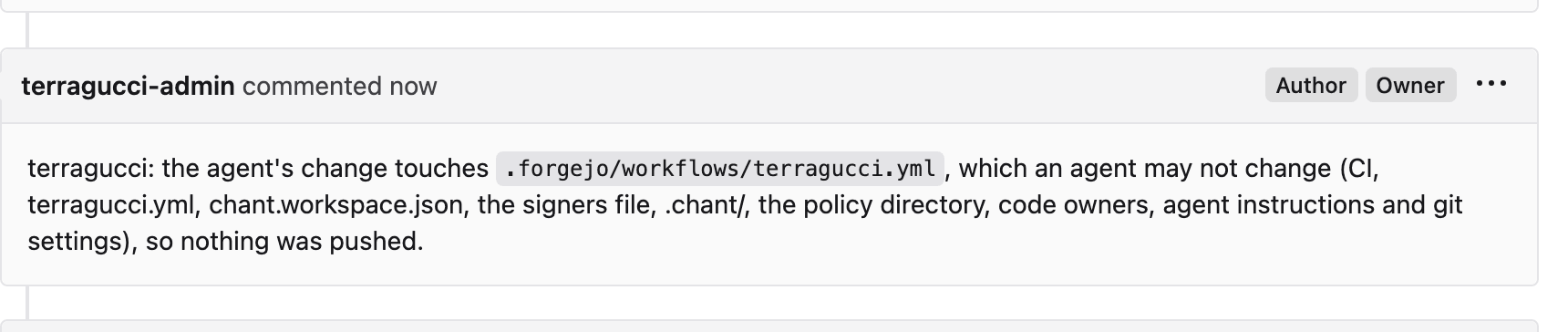
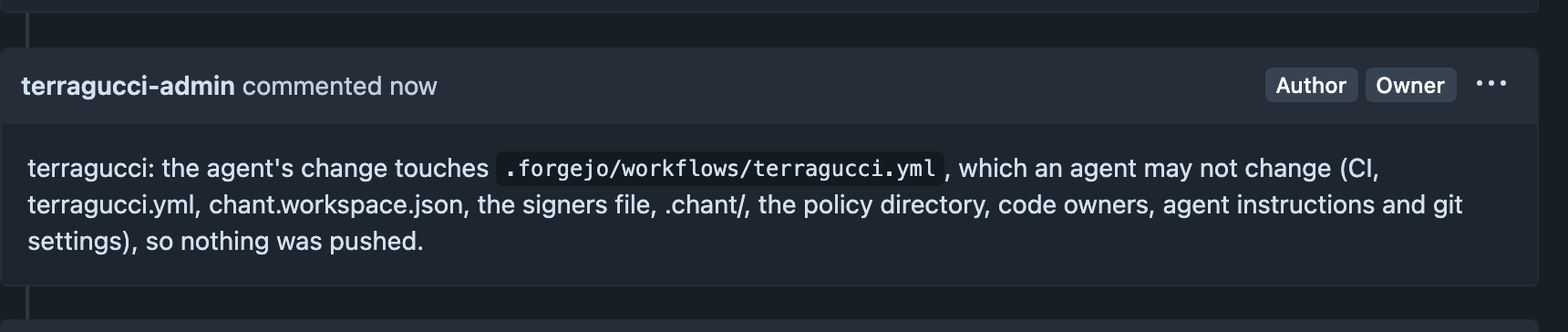
applies the patch to the same head in a fresh container; refuses one that touches a guarded path, with a reply naming the paths; pushes any other as one commit without force | the agent’s token |
| the plan job | plans the pushed change with its read-only role | the plan role |
On GitLab the comments job answers the note and starts a pipeline on the default branch with TERRAGUCCI_AGENT_MR, TERRAGUCCI_AGENT_NOTE and TERRAGUCCI_AGENT_HEAD. Both jobs run there from the default branch’s pipeline file. Each reads the merge request and the note from GitLab again before it acts. GitLab hands every job the project’s variables, so the agent runs under env -i and gets only the prompt and turn limit plus the model’s key.
| Guard | What it stops |
|---|---|
the ask reaches the agent as a prompt file (TG_AGENT_PROMPT), never on a command line |
the ask running in a shell |
the agent’s step clears GITHUB_TOKEN, FORGEJO_TOKEN, GITEA_TOKEN and the runner’s artifact and identity token variables; on GitLab it starts with an empty environment and a checkout whose remote holds no job token; neither agent job has a cloud role, whatever oidc says |
the agent pushing, commenting or calling the cloud itself |
agent-push refuses a patch that touches a guarded path: CI files (.gitlab-ci.yml and .gitlab/ among them), terragucci.yml, chant.workspace.json, .chant/, the signers file, the policy directory, CODEOWNERS and agent instruction files |
the agent changing the pipeline, the gate, the signers or the policy |
agent-push pushes to the same head, without force |
a lost commit: when the agent fails, hits its turn limit, or the pull request moves, the branch stays as it was |
the command below lets the agent edit files and run terragucci config check and terragucci init --dry-run, and loads no MCP server and none of the repository’s Claude Code settings |
any other command, web fetches and MCP tools |
The default command pins one release of Claude Code and runs it in print mode:
npx -y @anthropic-ai/claude-code@2.1.290 -p --max-turns "$TG_AGENT_MAX_TURNS"
  --permission-prompts none --setting-sources user --strict-mcp-config --no-session-persistence
  --tools "Read,Edit,Write,Glob,Grep,Bash"
  --allowedTools "Read" "Edit" "Write" "Glob" "Grep" "Bash(terragucci config check)" "Bash(terragucci init --dry-run)"
  --disallowedTools "WebFetch" "WebSearch" "mcp__*" "Edit(.git/**)"
The flags are in the Claude Code CLI reference.
Use another agent
Section titled “Use another agent”command takes any command line that reads a prompt on stdin and edits files in the working directory.
agent:
  via: forge
  token_env: AGENT_FORGE_TOKEN
  comment:
    command: my-agent --non-interactive
key_secret: MY_AGENT_KEY| Variable | Holds |
|---|---|
TG_AGENT_PROMPT |
the prompt’s path |
TG_AGENT_MAX_TURNS |
the turn limit |
the key_secret name |
the model’s key, under its own name |
agent-push refuses a guarded path whichever agent wrote the patch.
MCP or --json
Section titled “MCP or --json”| Where the agent runs | What it uses |
|---|---|
in the agent job |
the shell: terragucci config check and terragucci init --dry-run, which edit nothing. The default command loads no MCP server, and the job has no bucket credentials to give one |
| at your desk, before you ask | terragucci mcp to read the pull request’s plan reports (index, then report) and a root’s last apply; the CLI with --json to check a config it wrote |
- Re-plan a pull request from a comment plans again without changing anything.
- The generated pipeline lists the jobs and their tokens.

These docs count page views and clicks with PostHog. They set no cookies, store nothing in your browser, and send nothing when your browser asks not to be tracked.