
Turn on drift checks
 Optional: hand this page to your coding agentThe steps work by hand too.
Show the whole prompt
Read https://intentius.io/terragucci/guides/turn-on-drift-checks/.
Add a `drift:` cron to terragucci.yml, run `npx terragucci config check --json`
and `npx terragucci init`, and open a pull request. Tell me the GitLab schedule
or token scope I must set.
Never apply, approve (a pull request review or `terragucci approve`), override a policy denial (`terragucci override`), use `--mode apply`, or merge; never touch `.chant/allowed_signers` or `chant/lifecycle`.Result
Section titled “Result”A scheduled tf-drift run that plans every root, and one issue that groups what drifted like a pull-request plan.
Prerequisites
Section titled “Prerequisites”| You need | Why |
|---|---|
| The pipeline from Get your first plan note | init adds the drift job to it |
| A plan role that can read your cloud | drift plans use the same read-only role as pull requests |
| Terraform or OpenTofu roots, or Terragrunt units | the issue names roots, or units in a Terragrunt repo |
| A cron expression in UTC | forge schedulers read cron in UTC |
-
Set a schedule in
terragucci.yml. Pick an odd minute; forge schedulers are busiest on the hour.drift: "17 4 * * *" -
Check the file.
Terminal window npx terragucci config checkterragucci.yml: okapproval: ledger (the default)A bad value is listed as a problem, and the command exits 2.
-
Write the pipeline again and merge it.
Terminal window npx terragucci initinitadds adriftjob with the cron. Aworkflow_dispatchwith noprinput runs it by hand.Set the same cron under CI/CD, Schedules.
GITLAB_TOKEN(or thetoken_envvariable) needs theapiscope.Give the drift schedule no
TERRAGUCCI_SCHEDULEvariable. A schedule withTERRAGUCCI_SCHEDULEset tocommentsis the comments schedule, and its pipelines run no drift job.The same job and trigger as GitHub.
-
Wait for the first run, or start one.
terragucci stage tf-driftplans each root with-refresh-only, comparing state with real objects. Only an object changed or deleted outside Terraform counts as drift, and a merged but unapplied change does not. A choudoufu root under live resource markers plans in full instead (below). -
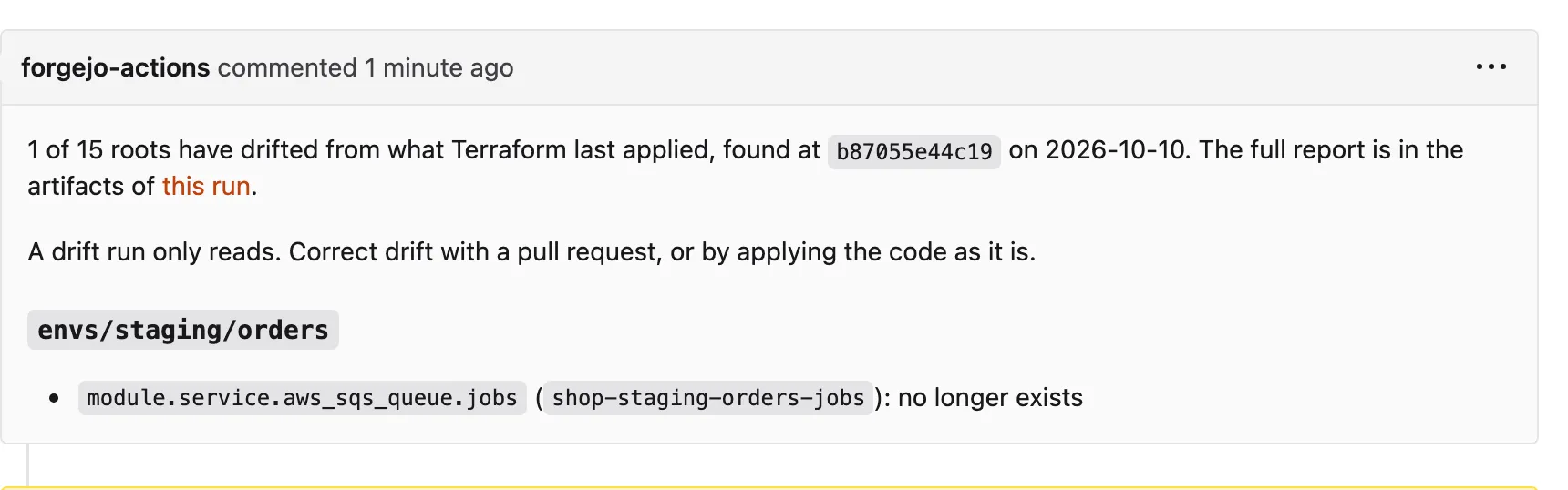
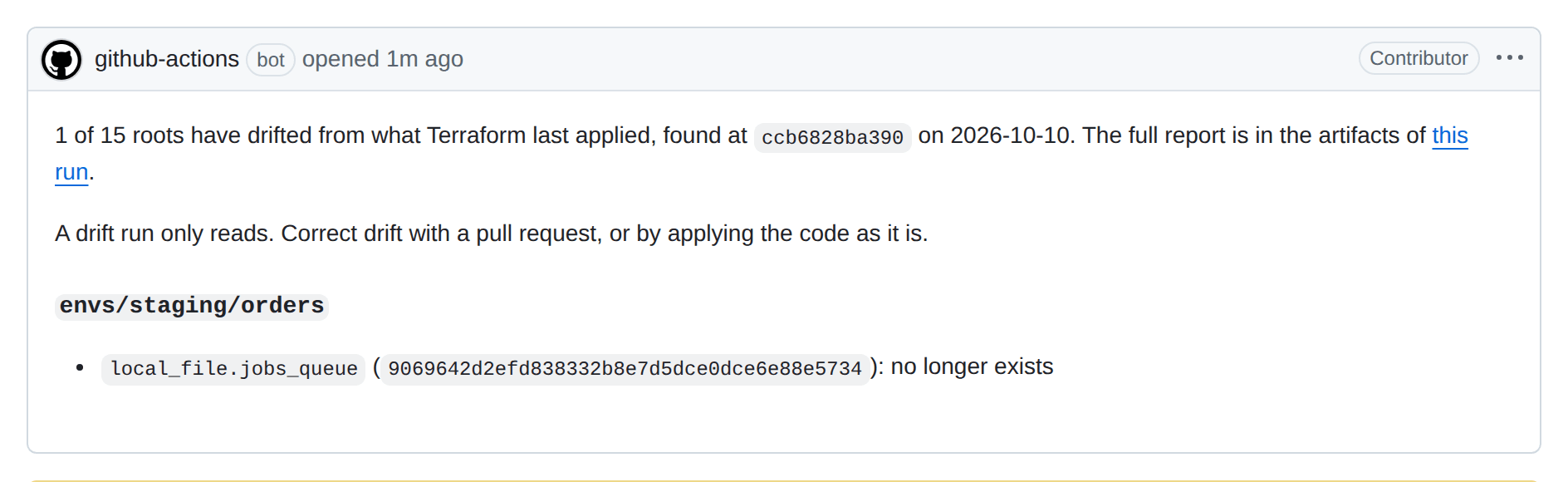
Read the issue.
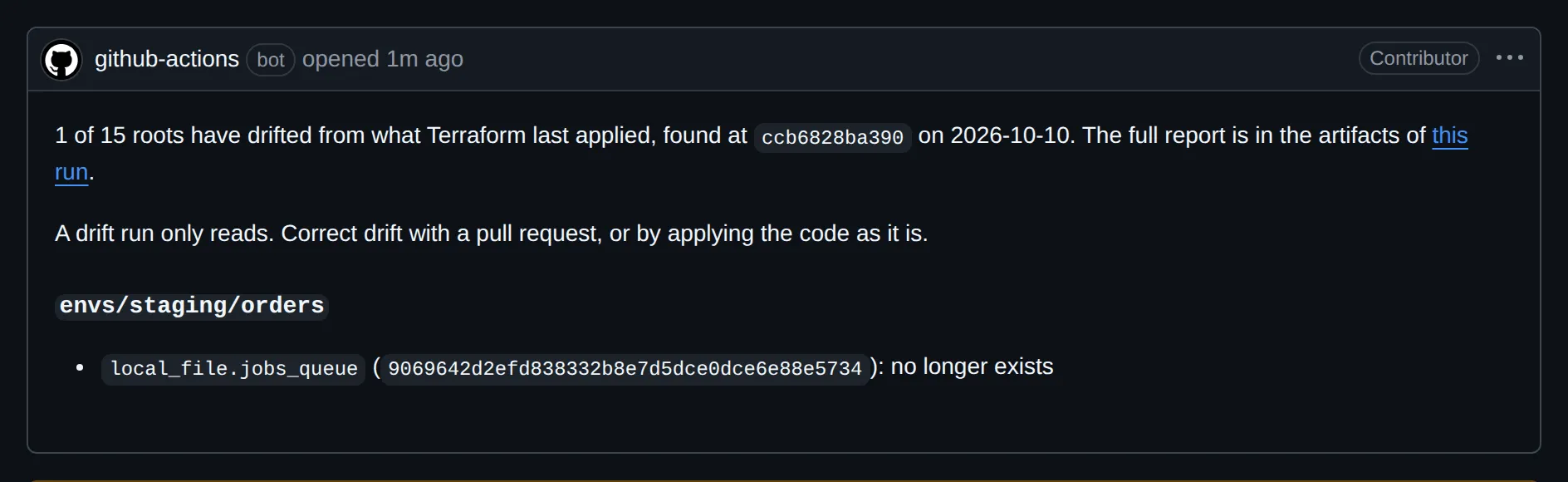
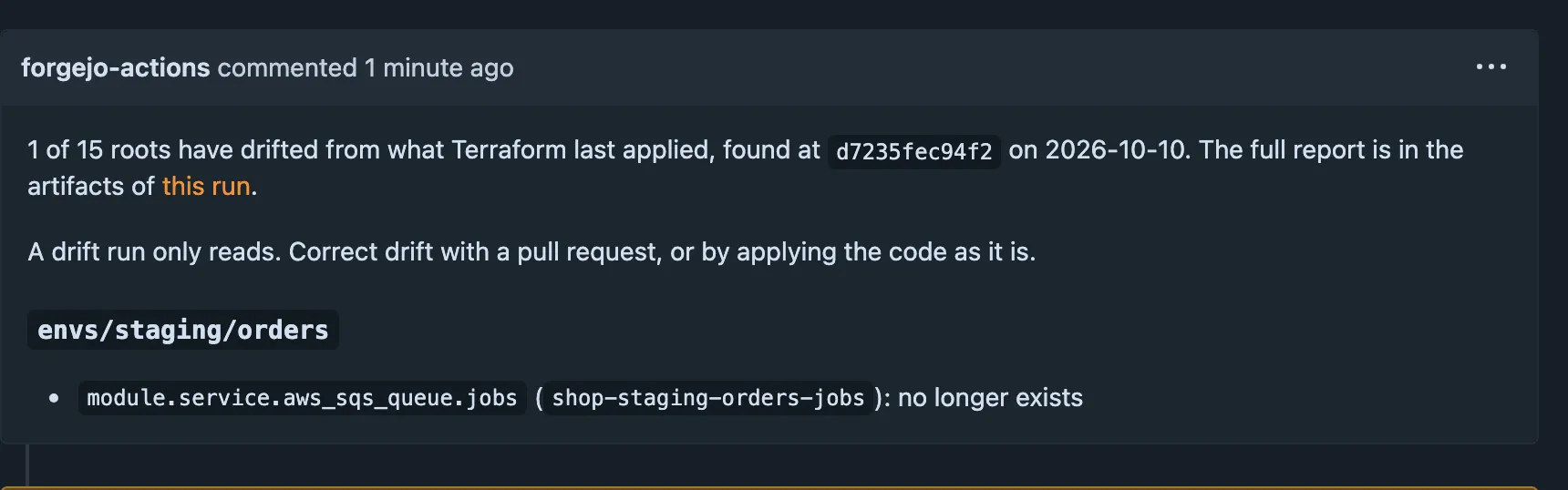
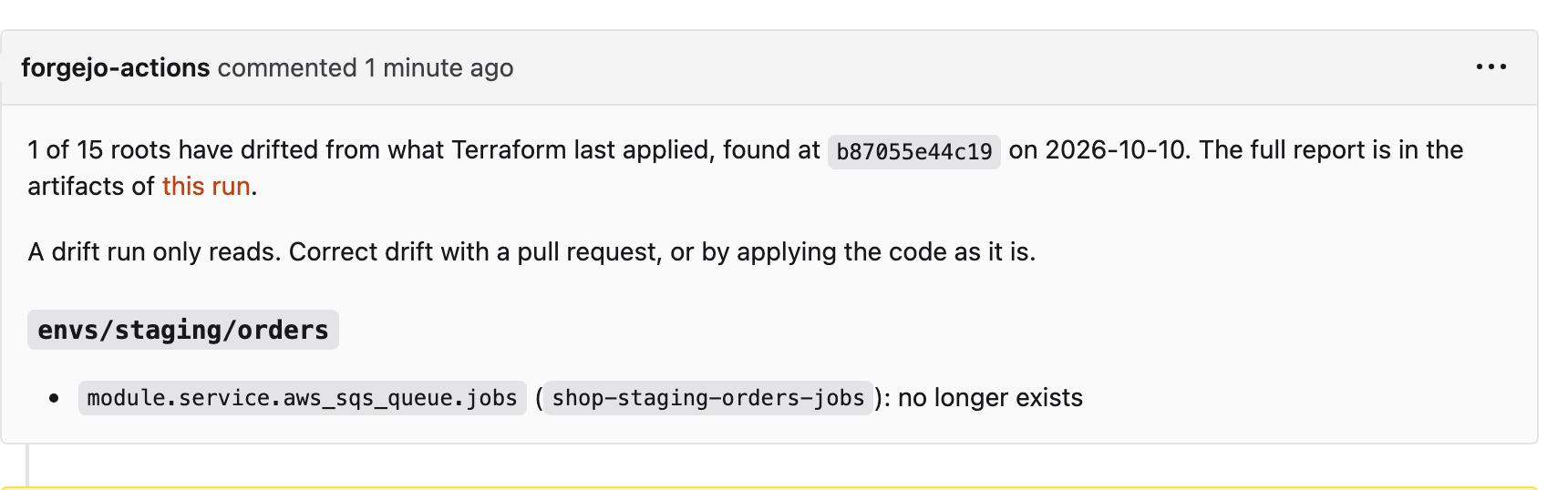
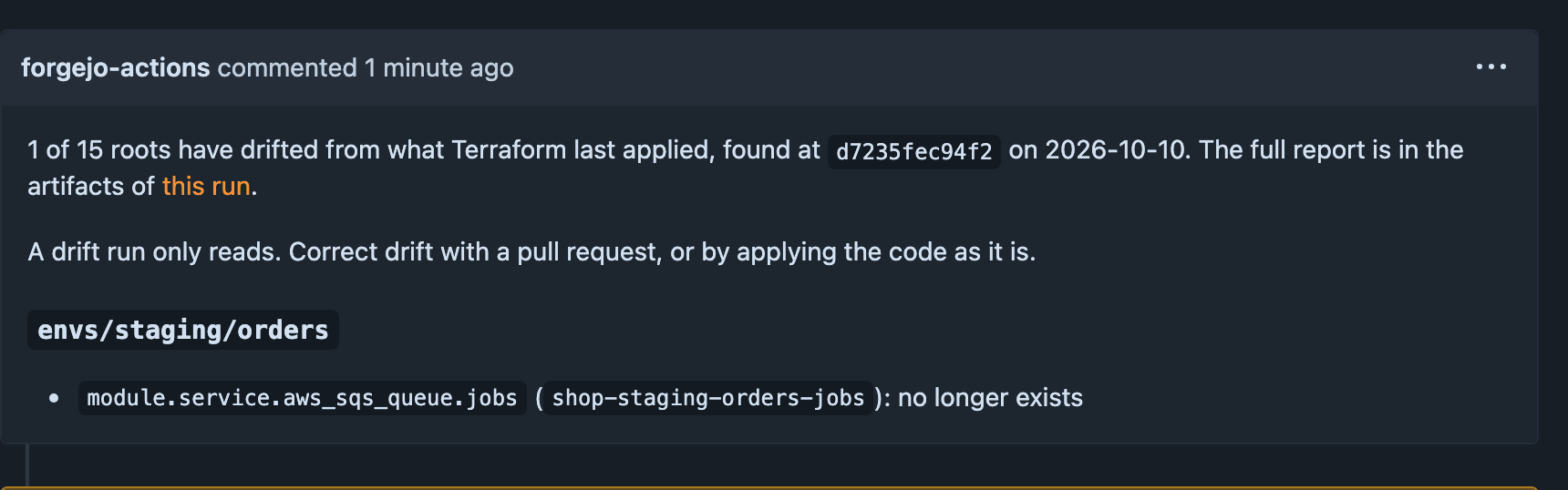
Each project has at most one open issue,
terragucci: drift found, which every run updates. A root that cannot be refreshed fails the job; drift alone does not.Event The issue Drift found opened, or updated if one is open Every root clean closed A root could not be planned left as it is 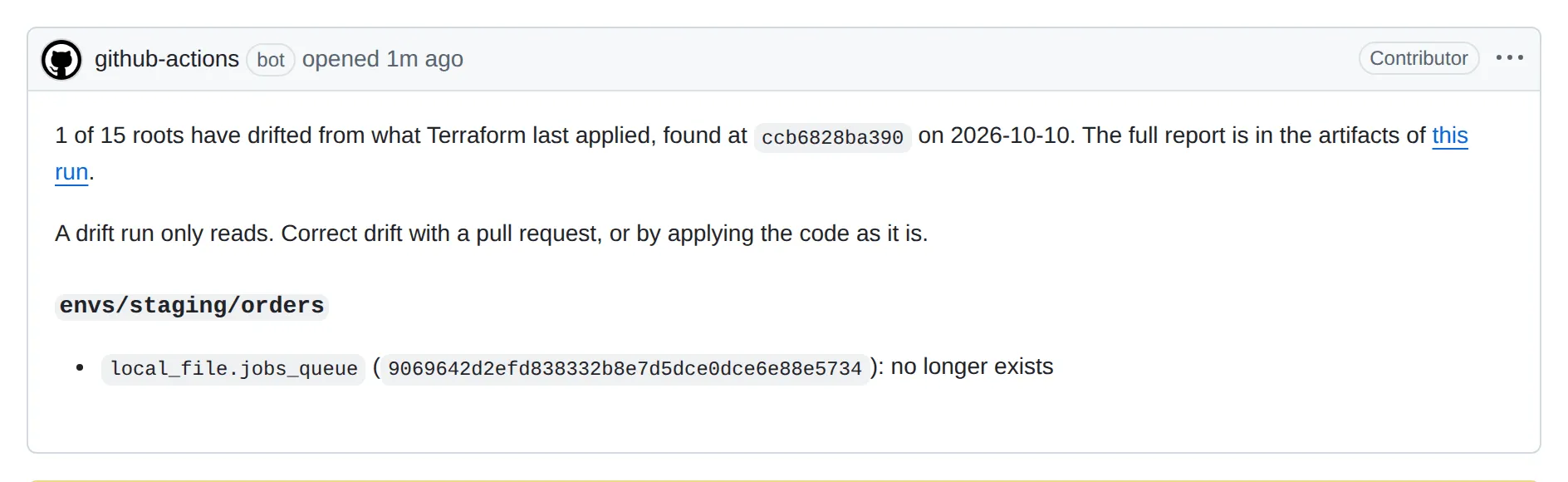


-
Remediate the drift.
With
respond.driftleft at its default, the drift job also opens a pull request fromterragucci/drift. It writes the live value where the root’s own resource block sets a literal, and adds an import block for a resource the state does not hold. Responses lists what is only reported.To Do Then keep the live value read the pull request, comment /terragucci planon it for its plan note (Re-plan from a comment), and merge itthe apply job applies it in waves, behind the gate like any change put the object back close the pull request and apply the root again the apply makes the object match the code A coding agent can take what the pull request cannot write (a value set through a variable or a module). Set
agent.driftand the drift issue starts an agent that returns its change as a pull request.Nothing in the drift job applies or merges. Each wave’s approval and each run’s report stay in the audit trail.
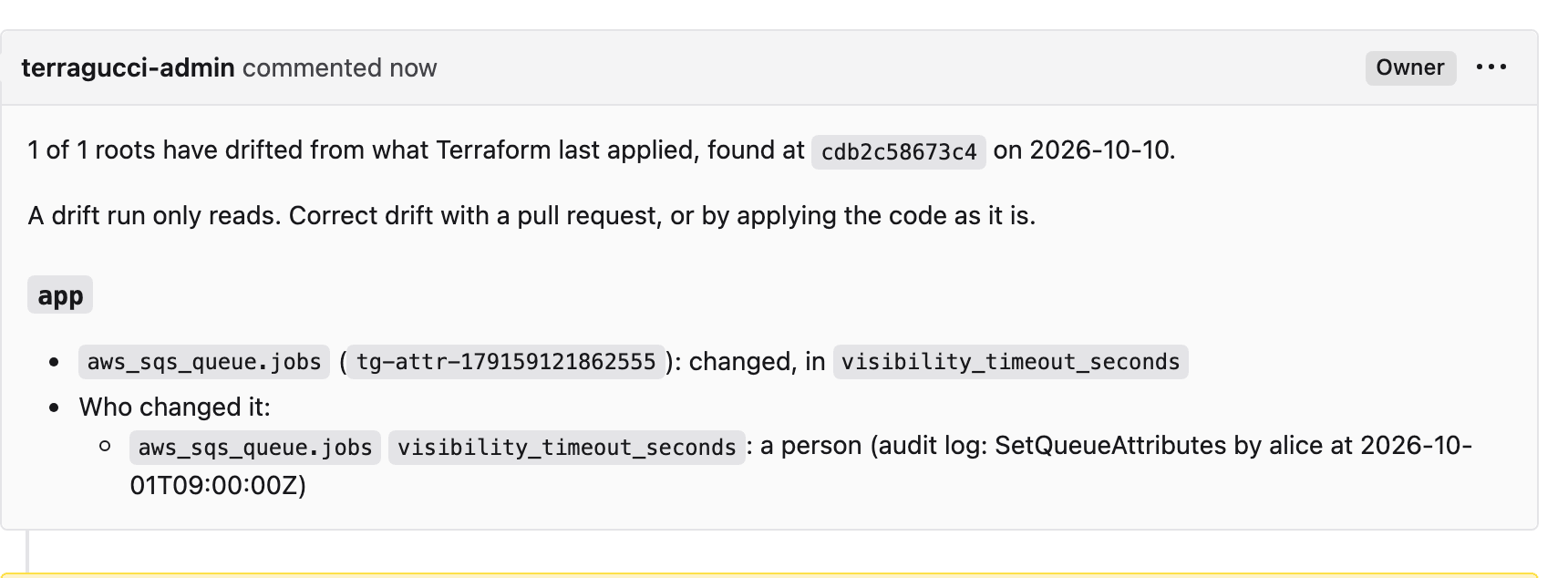
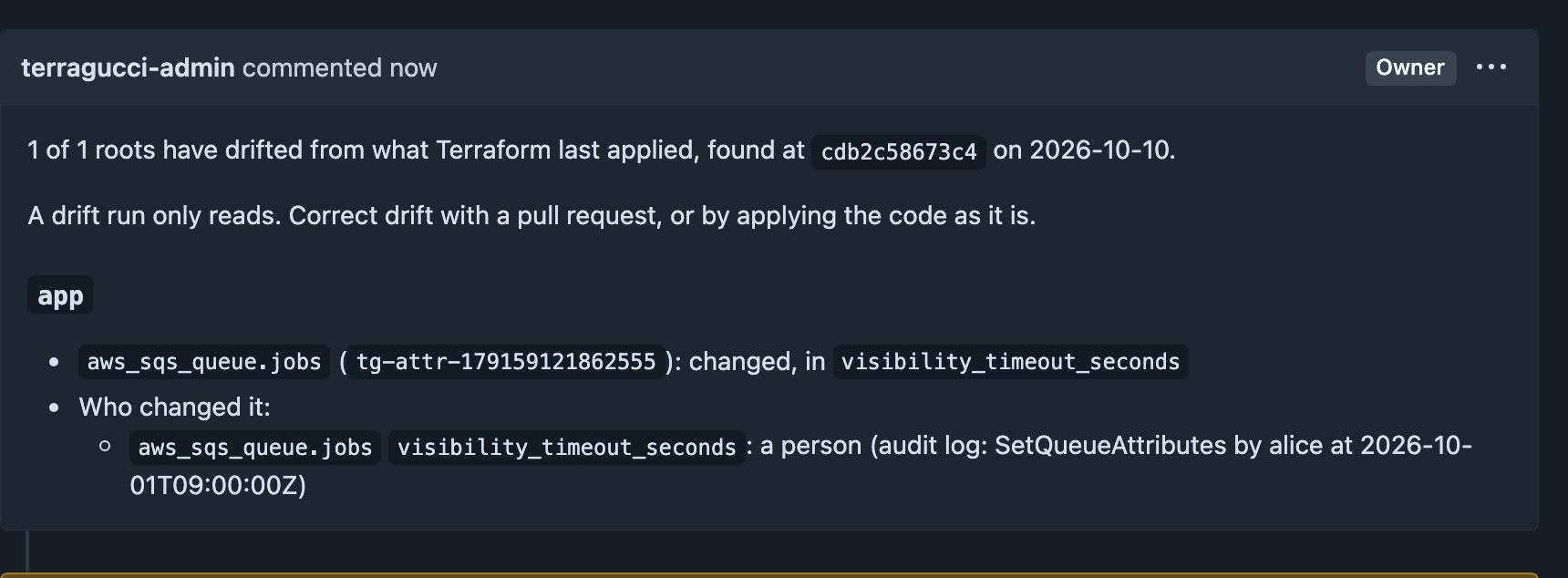
Under
respond.drift: attributethe issue also names each attribute’s changer from the audit log (Drift attribution):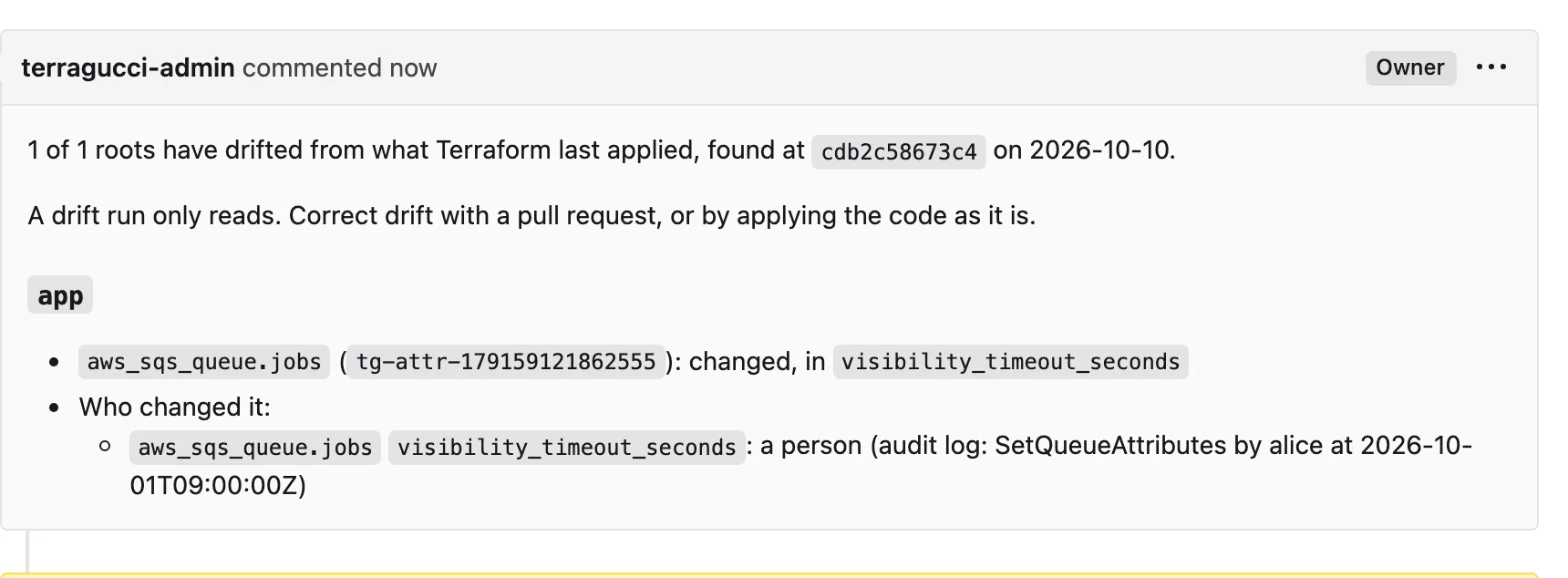
-
Watch for an overdue note.
When the schedule stops, the next pull request’s plan note says why the drift checks are overdue (Overdue drift checks).


Roots another branch applies
Section titled “Roots another branch applies”With apply.branches, the drift job checks a root that another branch applies against that branch’s code. The job runs on the default branch and plans the root in a checkout of its branch fetched from origin. The log names the branch and its commit:
apply.branches: envs/prod/app plans from release at 3f9a1c2e, the branch that applies itA provider, backend or version the branch sets differently is the one the check uses, so a difference between the two branches is never reported as drift. A root whose branch cannot be fetched fails its check with the reason; it is never checked against the default branch instead. In a Terragrunt repo, a branch’s units plan with one run --all in that branch’s checkout.
Live roots
Section titled “Live roots”A choudoufu root under live resource markers keeps no state to refresh: every plan of it reads the live system, and choudoufu refuses -refresh-only there. tf-drift plans such a root in full, and each change the plan would make is drift, read from the live side:
| The plan would | The issue says |
|---|---|
| change an attribute | the attribute changed |
| create a resource | it no longer exists |
| destroy a resource | it exists outside the code |
A change merged to the default branch but not applied yet also shows here, since the plan cannot tell it from a change made outside choudoufu. The rest of the drift job is the same: one issue, respond.drift and attribution.
- Stages lists what
tf-driftreads and writes.

These docs count page views and clicks with PostHog. They set no cookies, store nothing in your browser, and send nothing when your browser asks not to be tracked.